Abstract
摘要 / Abstract
飞行员周期体检里,最容易吵起来的不是血常规、尿常规这些项目,而是胸片、胸部CT、脑部MRI/MRT、牙科X光这些带“影像”两个字的检查。这里先把话说清楚:X光和CT是电离辐射,MRI/MRT不是;牙科小片和普通胸片剂量很低,胸部CT的剂量就高很多。单次标准检查一般不会造成急性伤害,这个不必自己吓自己。但如果把胸部CT做成每年、甚至更频繁的固定项目,问题就不是“照一次会不会完蛋”,而是“有没有必要一次又一次这样照”。医学上真正该问的是:这项检查能不能改变飞行适任判断?有没有低剂量或无电离辐射的替代办法?重复做的收益,能不能压过累积剂量和误筛查带来的代价(ICRP, 2007a, 2007b;IAEA, 2018;FDA, 2024)。
In pilot periodic medical examinations, the real argument is rarely about routine blood or urine tests. It usually starts with imaging: chest X-ray, chest CT, brain MRI/MRT, and dental X-rays. The categories need to be kept separate. X-ray and CT use ionizing radiation; MRI/MRT does not. Dental intraoral films and standard chest radiographs are low-dose examinations, while chest CT is in a different dose range. A single standard study usually will not cause acute injury, so there is no need to panic. The harder question is different: if chest CT becomes an annual or repeated default, what exactly is it finding that changes aeromedical certification, and could the same question be answered with a lower-dose or non-ionizing method?
Dose
一、先把剂量这笔账算清楚 / Start With the Dose
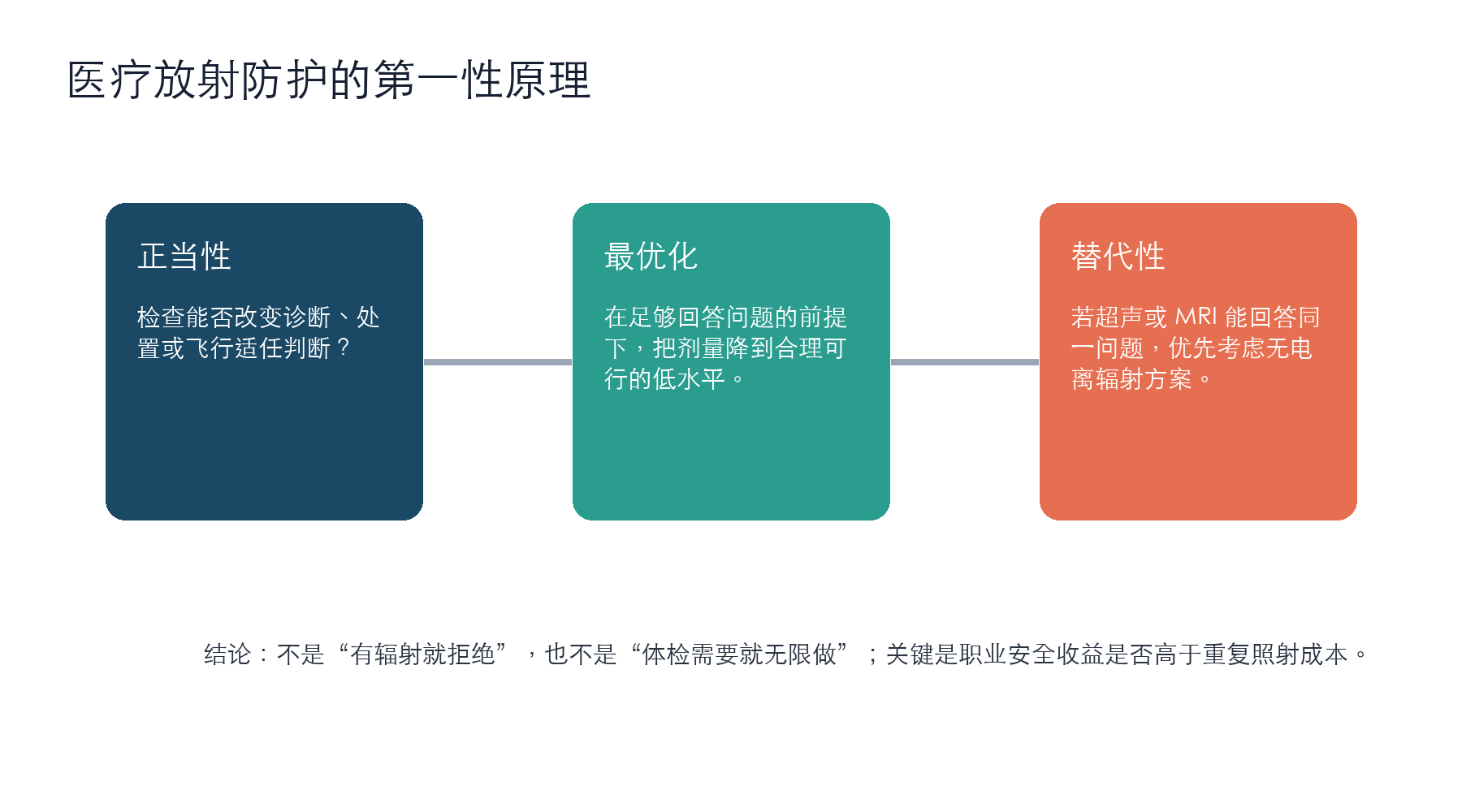
医学放射防护说到底就两件事:该不该做,以及能不能少照一点。所谓“正当性”,不是一句“体检需要”就结束了,而是检查结果要能影响诊断、处置或者飞行适任结论。所谓“最优化”,也不是把剂量压到图像都看不清,而是在够用的前提下少照。还要提醒一点:公众一年1 mSv之类的剂量限值,不能直接拿来套患者检查,因为患者接受医疗照射是为了获得诊断收益。反过来说,这也不能变成体检机构无限重复高剂量检查的通行证(ICRP, 2007a;IAEA, 2018;NHC, 2006)。
Radiation protection in medicine comes down to two plain questions: should this test be done, and can it be done with less exposure? Justification is not satisfied by saying that a checkup requires it; the result should affect diagnosis, management, or aeromedical fitness. Optimization does not mean lowering dose until the image is useless; it means using no more dose than is needed to answer the question. Public dose limits, such as 1 mSv per year, also cannot be pasted onto patient imaging, because medical exposure is accepted for diagnostic benefit. But that benefit has to be real, not assumed forever.
Imaging
二、X光、CT、MRI/MRT与牙科片:不要混在一起说
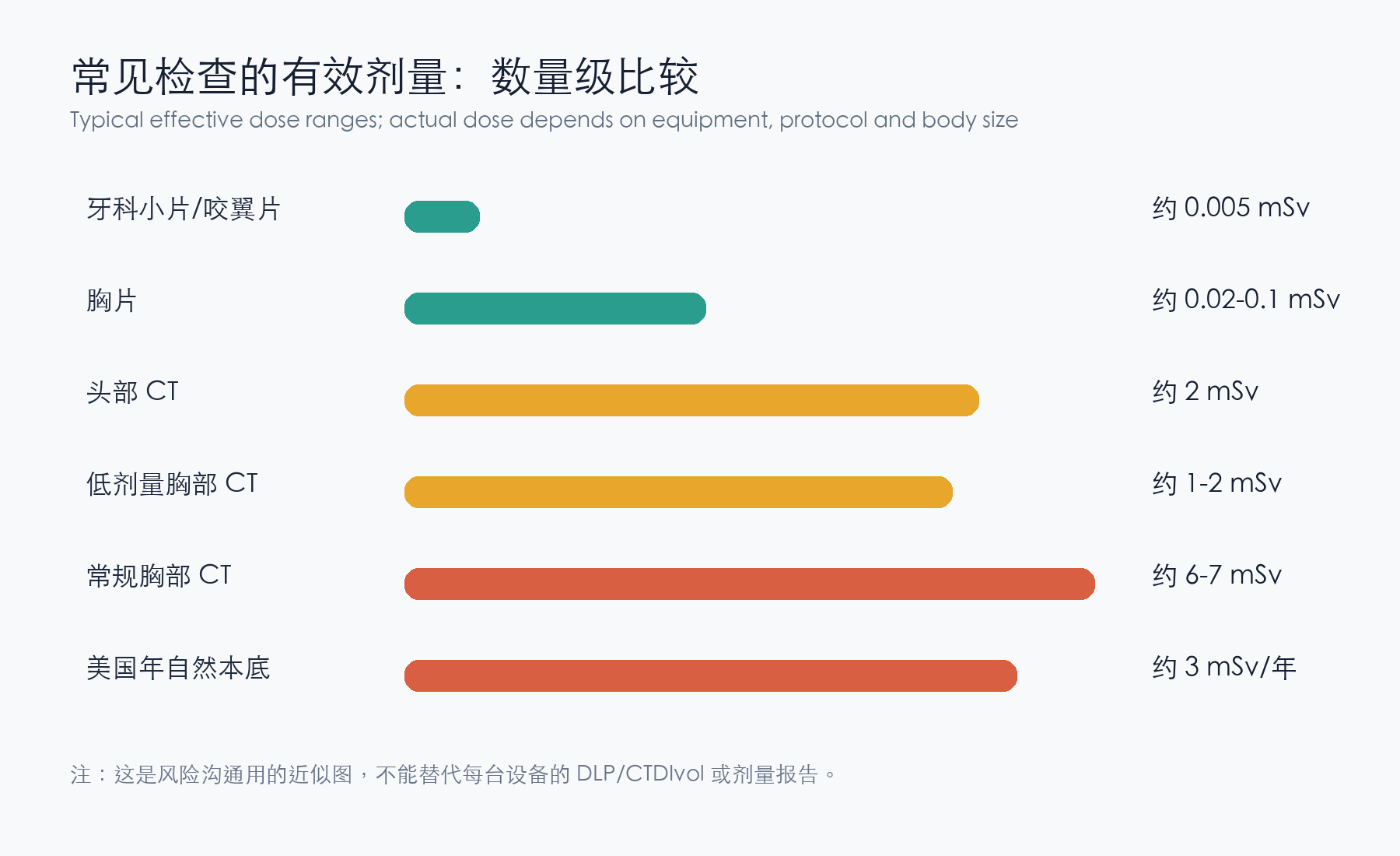
按常见数量级看,牙科咬翼片或局部小片大约0.005 mSv,胸片大约0.02-0.1 mSv,头部CT约2 mSv,低剂量胸部CT约1-2 mSv,常规胸部CT常在6-7 mSv上下。数字会随机器、体型、扫描范围和协议改变,所以不要把这些数值当成每个人的精确账单;但它足够说明一个事实:胸片和胸部CT不是一回事。MRI/MRT的重点则更简单,它没有电离辐射。它要担心的是强磁场、植入物、射频加热、幽闭恐惧、增强剂这些磁共振自己的问题,不是X射线的问题(FDA, 2023;RadiologyInfo, 2024;ACR, 2024)。
At a practical order of magnitude, a dental bitewing or intraoral film is roughly 0.005 mSv; a chest radiograph is about 0.02-0.1 mSv; a head CT is about 2 mSv; low-dose chest CT is often around 1-2 mSv; and a conventional chest CT is often around 6-7 mSv. These are not personal dose statements, because scanner model, protocol, body size, and scan range all matter. They are useful because they show that a chest radiograph and a chest CT are not the same thing. MRI/MRT is separate again: it delivers no ionizing radiation. Its safety issues are magnetic-field and contrast-related, not X-ray-related.
Aeromedical Screening
三、飞行员体检:必要,但不能无限外推
飞行员体检不是普通健康体检,它背后有公共安全的考虑。国外一类体检的逻辑,很多时候更接近短期预防医学:尽量降低未来半年或一年里突然失能、猝死、药物影响判断的概率。可是医学不是玄学,再严的体检也不可能把小概率事件清零。美国FAA一类体检在40岁前后有效期不同,欧洲EASA也会按年龄和运行类型调整一类体检有效期,这说明国际规则承认风险会随年龄和任务改变(FAA, 2024;EASA, 2024;ICAO, 2012)。真正的问题不是飞行员该不该体检,而是体检项目能不能跟风险对上号。
Pilot medical screening is not ordinary wellness screening; it carries a public-safety purpose. In many countries, the logic of a Class 1 medical is closer to short-term preventive medicine: reduce the chance of sudden incapacitation, cardiac death, drug impairment, or serious judgment problems over the next six or twelve months. But medicine is not magic. No examination, however strict, can drive low-probability events to zero. FAA and EASA validity periods change with age and operation type, which shows that international systems also scale oversight with risk. The real question is not whether pilots should be examined; it is whether each item matches a real risk.
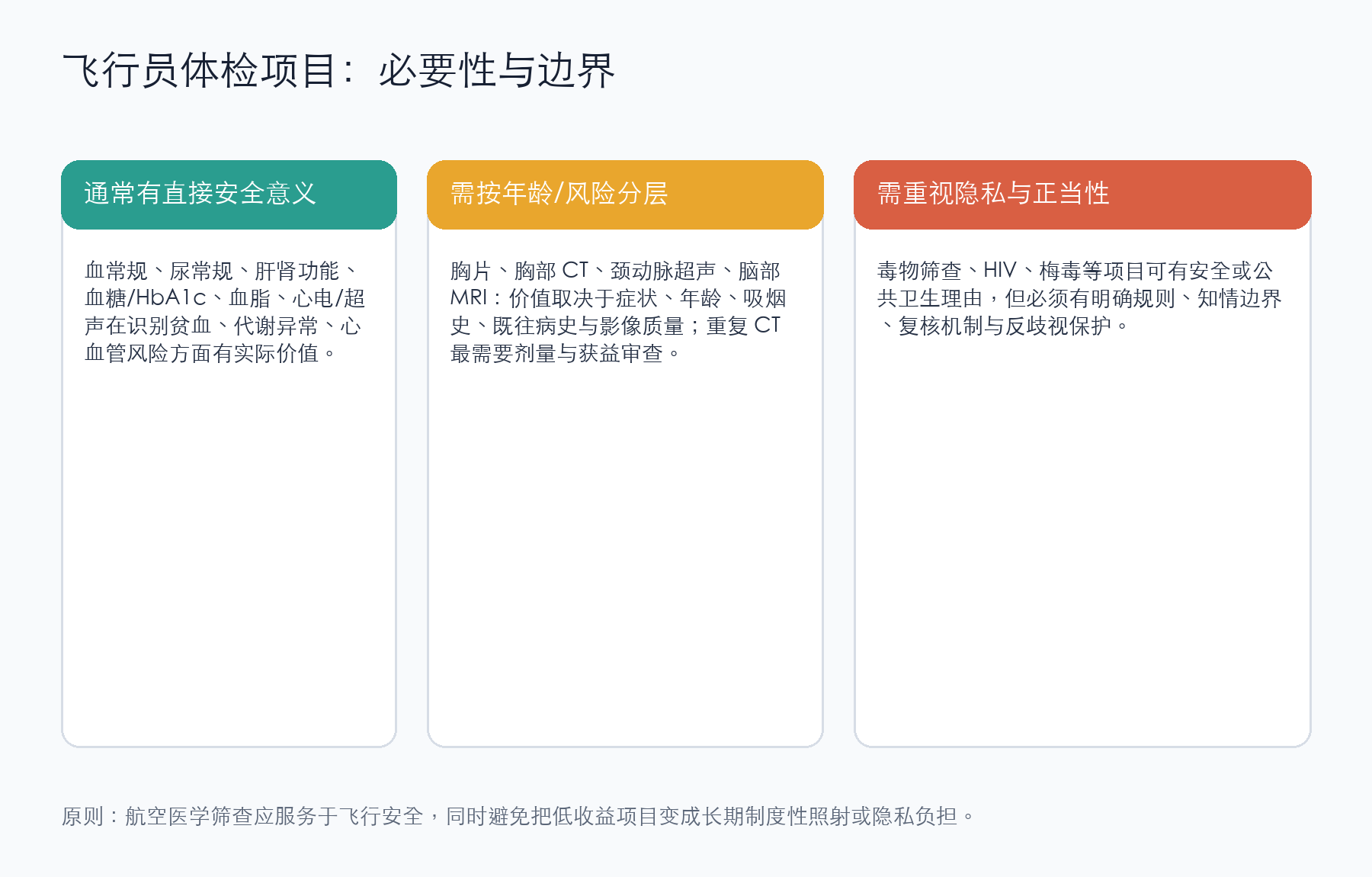
就笔者最近一次体检中的项目而言,血常规、尿常规、肝肾功能、血糖/HbA1c、血脂这些项目,负担低、没有辐射,对发现贫血、感染线索、糖代谢异常、肾功能、肝功能和心血管风险有实际价值。心超和颈动脉B超也没有电离辐射。报告里提到的左侧颈总动脉分叉处斑块、主动脉瓣微量反流,重点不是“辐射伤害”,而是回到心血管风险管理:血脂、血压、吸烟史、家族史、运动、复查间隔,这些才是该跟进的地方。相较之下,如果胸部CT被做成人人固定、年年固定的项目,医学正当性就必须讲得更明白。
Looking at the items from my recent examination, the blood count, urinalysis, liver and kidney panels, fasting glucose/HbA1c, and lipid tests are low-burden and non-radiating. They have practical value for anemia, infection clues, metabolic problems, renal and hepatic function, and cardiovascular risk. Echocardiography and carotid ultrasound also do not use ionizing radiation. The reported carotid plaque and trace aortic regurgitation are not radiation issues; they point back to cardiovascular risk management: lipids, blood pressure, smoking history, family history, exercise, and follow-up interval. Chest CT is the item that needs a clearer explanation if it is applied to everyone on a routine schedule.
Detox
四、所谓“排辐射”:多数是生意,不是医学
常规X光和CT属于外照射。机器关掉,照射结束,人不会因此变成“带辐射的人”,也没有什么东西需要从体内排出来。多喝水有时对排出含碘造影剂有帮助,前提是医生允许、肾功能也适合;但那排的是造影剂,不是辐射。碘化钾、普鲁士蓝、DTPA这些药物,是核事故或放射性物质进入体内以后,针对特定污染物使用的东西。碘化钾只管放射性碘进入甲状腺这件事,不能抵消CT,也不能保护全身(CDC, 2024;WHO, 2017)。至于网上那些祖传秘方、维生素、保健品、补品,听听就好。我个人的看法是:别把焦虑喂给商家。
Routine X-ray and CT are external exposures. When the machine stops, the exposure is over. The body does not become radioactive, and there is no radiation left to flush out. Drinking water may help clear iodinated contrast in the right patient, if the physician allows it and kidney function is appropriate; that clears contrast, not radiation. Potassium iodide, Prussian blue, and DTPA are countermeasures for specific internal contamination after nuclear or radiological incidents. Potassium iodide is for radioactive iodine uptake by the thyroid. It does not undo a CT scan and does not protect the whole body. Most online “radiation detox” products are selling anxiety, not medicine.
Questions
五、质疑要打在点上
对飞行员群体来说,最有效的质疑不是笼统喊“X光会不会把人照坏”,这样很容易被一句“剂量很小”带走。更好的问法是四个具体问题:胸部CT比胸片或低剂量CT多发现了什么,而且这些发现会不会改变飞行适任结论?这台机器、这个协议的CTDIvol、DLP和估算有效剂量是多少?以我的年龄、病史、岗位和风险层级,为什么需要这个频率?既往影像能不能复用,避免同一个问题重复扫描?问到这里,讨论才真正进入医学和制度层面。
For pilots, the strongest challenge is not a broad claim that X-rays are harmful. That can be brushed aside with the answer that the dose is small. Better questions are specific: What does chest CT find beyond chest radiography or low-dose CT, and would those findings change aeromedical certification? What are the CTDIvol, DLP, and estimated effective dose for this protocol? Given my age, history, duty, and risk category, why is this interval necessary? Can prior imaging be reused so the same question is not scanned again? These questions move the discussion from fear to auditability.
Conclusion
结论 / Conclusion
综前所述,笔者的判断很简单:单次牙科片、胸片、头部CT或胸部CT,通常不构成急性伤害,不需要把自己吓坏;但把CT变成长期、固定、重复的职业筛查项目,就必须拿出更扎实的理由。飞行员当然需要比普通人更严肃地面对短期失能风险,这是职业的特殊性。但公共安全不能变成一把万能钥匙,拿来打开所有高强度筛查的大门。航空体检该有边界:目的要清楚,范围要收住,剂量要透明,替代方案要摆出来。能做到这些,讨论才不会滑向两个极端:一边是无条件服从,一边是无根据恐慌。
My position is straightforward: a single dental film, chest radiograph, head CT, or chest CT usually does not cause acute harm, and there is no need to frighten ourselves. But if CT becomes a long-term, fixed, repeated occupational screening item, the justification must be stronger. Pilots do need more serious monitoring for short-term incapacitation risk than the general public; that is part of the job. Public safety, however, cannot be used as a master key to justify every high-intensity screening item. Aeromedical screening needs boundaries: the purpose should be clear, the scope restrained, the dose transparent, and alternatives openly considered. Otherwise the discussion falls into two bad camps: unconditional compliance on one side and unsupported panic on the other.
References
参考文献
- American College of Radiology. (2024). ACR manual on MR safety. https://www.acr.org/Clinical-Resources/Radiology-Safety/MR-Safety
- American Dental Association & U.S. Food and Drug Administration. (2012). Dental radiographic examinations: Recommendations for patient selection and limiting radiation exposure. https://www.fda.gov/radiation-emitting-products/medical-x-ray-imaging/dental-radiography
- Centers for Disease Control and Prevention. (2024). Potassium iodide (KI). https://www.cdc.gov/radiation-emergencies/treatment/potassium-iodide.html
- Centers for Disease Control and Prevention. (2024). Prussian blue. https://www.cdc.gov/radiation-emergencies/treatment/prussian-blue.html
- European Union Aviation Safety Agency. (2024). Easy Access Rules for Aircrew: Part-MED, MED.A.045. https://www.easa.europa.eu/en/document-library/easy-access-rules
- Federal Aviation Administration. (2024). 14 CFR § 61.23: Medical certificates: Requirement and duration. https://www.ecfr.gov/current/title-14/chapter-I/subchapter-D/part-61/subpart-A/section-61.23
- International Atomic Energy Agency. (2018). Radiation protection and safety in medical uses of ionizing radiation (SSG-46). https://www.iaea.org/publications/11102/radiation-protection-and-safety-in-medical-uses-of-ionizing-radiation
- International Civil Aviation Organization. (2012). Manual of civil aviation medicine (Doc 8984). https://www.icao.int/publications/
- International Commission on Radiological Protection. (2007a). The 2007 recommendations of the International Commission on Radiological Protection (ICRP Publication 103). https://www.icrp.org/publication.asp?id=ICRP%20Publication%20103
- International Commission on Radiological Protection. (2007b). Radiological protection in medicine (ICRP Publication 105). https://www.icrp.org/publication.asp?id=ICRP%20Publication%20105
- National Academies of Sciences, Engineering, and Medicine. (2006). Health risks from exposure to low levels of ionizing radiation: BEIR VII Phase 2. https://nap.nationalacademies.org/catalog/11340/
- RadiologyInfo.org. (2024). Radiation dose from X-ray and CT exams. https://www.radiologyinfo.org/en/info/safety-xray
- U.S. Food and Drug Administration. (2023). MRI (magnetic resonance imaging). https://www.fda.gov/radiation-emitting-products/mri-magnetic-resonance-imaging
- U.S. Food and Drug Administration. (2024). What are the radiation risks from CT? https://www.fda.gov/radiation-emitting-products/medical-x-ray-imaging/what-are-radiation-risks-ct
- World Health Organization. (2017). Iodine thyroid blocking: Guidelines for use in planning for and responding to radiological and nuclear emergencies. https://www.who.int/publications/i/item/9789241550185